
 FR
FR  DE
DE  PT
PT  ES
ES 
If you’re seriously considering Aliyah, the tax question is one of your biggest sources of stress. You’re not alone. Many Americans worry about double taxation, complicated reporting rules, and what happens to their investments, retirement accounts, and income once they move abroad.
 While the system is complex, Israel offers one of the most generous tax frameworks in the world for new immigrants. In fact, many Israeli citizenship tax benefits Americans receive are specifically designed to make the transition financially attractive — not burdensome.
In this guide, you’ll learn how the 10-year tax exemption works, what you still owe the IRS, and how to think about your financial life across both countries. By the end, you’ll have a clear, realistic picture — not just theory, but what it actually means for you.
Tell us, in your own words, what you are weighing. A principal of the office will respond personally within two business days.
Talk to a specialist.
Find out in 15 minutes
if you qualify.
What the 10-Year Oleh Tax Exemption Actually Covers
If you’re eligible under the Law of Return, you may qualify for one of the most powerful financial incentives available anywhere for immigrants. The Law of Return allows Jews, their children, grandchildren, and certain spouses to obtain Israeli citizenship. Once you officially make Aliyah, you’re classified as an Oleh Chadash (new immigrant), which is where the tax benefits begin.
The “Oleh tax exemption” often called the 10-year tax holiday Israel offers applies specifically to foreign-sourced income and assets that you bring with you or already own before making Aliyah. Here’s what is typically covered:
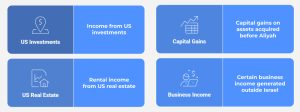

What’s not covered:
- Income earned from work performed inside Israel
- Salary from an Israeli employer
- Income from an Israeli business
In addition to tax benefits, new Olim may also receive direct financial support through Sal Klita (the “absorption basket”). This is a series of monthly payments provided by the Israeli government during your first months in the country to help cover initial living expenses like rent, utilities, and basic setup costs.
While the exact amount depends on your family size and status, many American families are surprised to learn they receive several thousand dollars in total support during their transition. It’s not a long-term income stream — but it can significantly ease your financial runway during the early stages of Aliyah.
Example
During your first 10 years in Israel:
- Your investment income may be exempt from Israeli tax
- Your remote work income may qualify as foreign-sourced, depending on structure (this requires careful planning)
- But if you take a local Israeli job, that income is fully taxable in Israel!
At Israel’s top marginal rate of ~50%, that’s potentially $10,000+ per year in Israeli tax you wouldn’t owe. This is why planning before your move matters — how your income is classified can significantly impact your tax outcome. Israel is not trying to tax your existing wealth during your first decade. It’s giving you time to transition — which leads directly to the other half of the equation: the US.
 That means income that was previously exempt may now be taxed in Israel at regular rates, depending on how it’s classified. This is why long-term planning matters just as much as your initial Aliyah strategy — decisions you make before and during your move can significantly impact your tax exposure once the exemption period ends.
In some cases, individuals who previously lived in Israel and later return may qualify as a veteran returning resident, potentially receiving a similar 10-year tax exemption again — but eligibility rules are strict and highly fact-specific, so it’s essential to review your status with a qualified advisor before relying on this benefit.
The US Side of the Equation — FBAR, FATCA, and Why You Still File with the IRS
No matter where you live, the United States taxes its citizens on worldwide income. That doesn’t change when you make Aliyah — and it’s one of the biggest misconceptions Americans have. The good news is that while you still file, you’re not necessarily paying tax twice on the same income.
How Americans Making Aliyah Taxes Are Managed
There are two primary tools the IRS provides to reduce double taxation:
- Foreign Earned Income Exclusion (FEIE): Allows you to exclude a portion of earned income if you meet residency tests
- Foreign Tax Credit (FTC): Lets you offset US taxes with taxes paid to Israel
These don’t eliminate complexity, but they help prevent the worst-case scenario of being taxed twice on everything.
Example
If you earn income in Israel and pay Israeli tax on it, you can often apply those taxes as a credit against your US liability. The result? In many cases, you pay the higher of the two systems — not both. That said, this is an area where professional guidance is essential.
FBAR, FATCA, and Israeli Bank Accounts
Once you move to Israel, you’ll likely open local bank accounts. This triggers additional US reporting requirements.
FBAR (Foreign Bank Account Report):
- Required if your total foreign account balances exceed $10,000 at any point during the year
- Filed separately from your tax return
- Penalties for non-compliance can exceed $10,000 per violation
FATCA (Foreign Account Tax Compliance Act):
- Requires reporting certain foreign financial assets on your US tax return
- Israeli banks may also report your accounts to the IRS
This can feel invasive, but it’s standard for US expats worldwide. Another important point: if you’re receiving US Social Security benefits, those payments generally continue while living in Israel. If you’re worried about being “taxed twice on everything,” here’s the reality: with proper use of credits and exclusions, most Americans don’t face true double taxation — but they do face ongoing compliance.
Capital Gains, Retirement Accounts, Real Estate
Once you move beyond the basics, the real financial impact of Aliyah comes down to how your specific assets are treated. This is where thoughtful planning can make a meaningful difference.
Retirement Accounts, Investments, and Pre-Aliyah Assets
If you have a 401(k), IRA, or brokerage account in the US, your situation depends heavily on timing and structure.
In general:
- Assets acquired before Aliyah may fall under the foreign income exemption Israel provides
- Appreciation that occurred before your move may receive favorable treatment
- Distributions from retirement accounts can be complex and require coordination between US and Israeli rules
Example
Similarly:
- Dividends and interest from US accounts during the 10-year exemption period may be exempt from Israeli tax
- Capital gains realized on pre-Aliyah investments may also qualify for exemption
However, the US will still tax these distributions — which is why coordination is critical.
Real Estate in Israel: Mas Rechisha and First-Time Benefits
If you’re planning to buy property in Israel, there are meaningful incentives available to new Olim. One of the most important is mas rechisha (Israeli property purchase tax). As a new immigrant:
In addition, the Ministry of Absorption may offer:
These programs are designed to lower the barrier to homeownership — but eligibility and benefits vary.
Business Owners and Remote Workers
If you’re self-employed or working with US clients, your structure matters more than ever. In some cases:
- Income generated from US clients may qualify as foreign-sourced
- This could potentially fall under the 10-year exemption
For example: a freelance consultant earning $120,000 from US clients while living in Tel Aviv may not automatically qualify for exemption. The details of how the business is structured — and where value is created — are critical. This is one of the most common areas where Americans make costly assumptions.
In other words, the tax outcome of your Aliyah isn’t determined by one rule — it’s the result of how all these pieces fit together. Small decisions about timing, structure, and classification can have long-term financial consequences. And that’s exactly where many Americans get it wrong — not because the benefits aren’t there, but because they misunderstand how to use them.
The 3 Mistakes Americans Make When Planning Their Aliyah Taxes
Even financially savvy Americans run into trouble when they underestimate how different the system is. Here are the three most common and avoidable mistakes.
1. Assuming Israel and the US have a full tax treaty
Many people believe there’s a comprehensive Israel tax treaty that prevents double taxation across the board. There isn’t. While there are limited agreements covering specific issues, there is no full income tax treaty like the US has with some other countries. That means coordination between systems is more complex — and requires planning.
2. Missing FBAR deadlines after moving
It’s easy to overlook reporting requirements during a major life transition. But the IRS doesn’t overlook them. If your foreign accounts exceed $10,000 and you fail to file an FBAR, penalties can reach $10,000 or more per violation — even if no tax is owed.
3. Waiting too long to start planning
This is the most expensive mistake. Your 10-year Israel new immigrant tax exemption starts the day you become a resident — not when you organize your finances. If you restructure assets after moving instead of before, you may miss out on benefits that could have been preserved.
What to Do Before, During, and After Your Aliyah
- Before Aliyah: Create a full inventory of income sources, investments, and accounts. Speak with a US-Israel tax professional about structuring assets
- During Aliyah: Ensure your Oleh status is properly registered for tax purposes
- After Arrival: Register with Israeli tax authorities and open compliant accounts. Ongoing: Maintain US filings (including FBAR Israel requirements) and review annually with an advisor
Done correctly, this process turns complexity into opportunity — not risk.
FAQ
Yes. The US taxes its citizens on worldwide income regardless of residence, and Israel taxes residents on applicable income. However, tools like the Foreign Tax Credit and Foreign Earned Income Exclusion help reduce double taxation. With proper planning, most Americans don’t pay full tax in both countries on the same income, but they must still file in both systems.
The 10-year exemption allows new immigrants to Israel to avoid Israeli tax on foreign-sourced income and certain assets acquired before Aliyah. This includes investment income, foreign rental income, and some business earnings. It does not apply to Israeli-sourced income, and the exemption period begins on your official Aliyah date.
There is no comprehensive income tax treaty that fully eliminates double taxation between the US and Israel. While some limited agreements exist, Americans must still navigate both tax systems. This makes professional tax planning especially important when coordinating income, credits, and reporting obligations across both countries.
Yes. US citizens must file annual tax returns regardless of where they live. This includes reporting worldwide income, even if you also pay taxes in Israel. Additional forms, such as FBAR or FATCA disclosures, may also be required depending on your financial situation.
Your retirement accounts remain in the US, but their tax treatment can become more complex. Distributions may be taxed by the US and potentially treated differently in Israel. Some benefits may apply to pre-Aliyah assets under the exemption rules, but this depends on structure and timing. Professional advice is strongly recommended.
Yes. If the combined value of your foreign accounts exceeds $10,000 at any time during the year, you must file an FBAR. Failure to do so can result in significant penalties. You may also need to report accounts under FATCA rules as part of your US tax return.
Yes. New Olim may qualify for reduced purchase tax rates (mas rechisha) on their first property, along with potential mortgage assistance programs. These benefits are time-sensitive and depend on meeting eligibility criteria, so it’s important to plan your purchase accordingly.
This depends on how your income is classified. Even if your employer is in the US, income may be considered Israeli-sourced if the work is performed in Israel. In some cases, structuring may allow partial benefits under the exemption rules, but this requires careful planning with a qualified advisor.
Yes — absolutely. The interaction between US and Israeli tax systems is complex, and small decisions can have long-term financial consequences. Working with a professional experienced in both jurisdictions helps you structure your finances correctly before your move and avoid costly mistakes later.
This article is for informational purposes only and does not constitute legal or tax advice. Readers should consult a licensed US and Israeli tax professional before making any financial decisions related to Aliyah.
